

As I keep reviewing the feedback this blog has received over the three quarters of a year it has existed, it’s become pretty clear that some readers are more into the punk stuff, others prefer politics, and some are mainly curious about life in London. But overall, the response has been overwhelmingly positive. At the same time, it’s obvious that especially those who don’t know me personally would appreciate more information about me as a person — about my life — to help them better understand my views and attitudes. For some, reading this blog really can feel a bit like “jumping onto a moving train.”
I thought about it for a long time and eventually decided to take a trip into my own past and piece together the key moments of my life, including the people and events that shaped me over the years. Now I’d like to share some of that journey with you.
Childhood on the Courts
Sometime in the late seventies, when I was seven, my dad took me — after I’d tried hockey and swimming — to the tennis club TJ TMS Pardubice. Tennis grabbed me from the very first moment. I started training in a group led by the legendary Jiří Richter, a former 1st league hockey player who, after ending his hockey career, moved to the tennis courts and devoted himself to coaching the youngest kids.
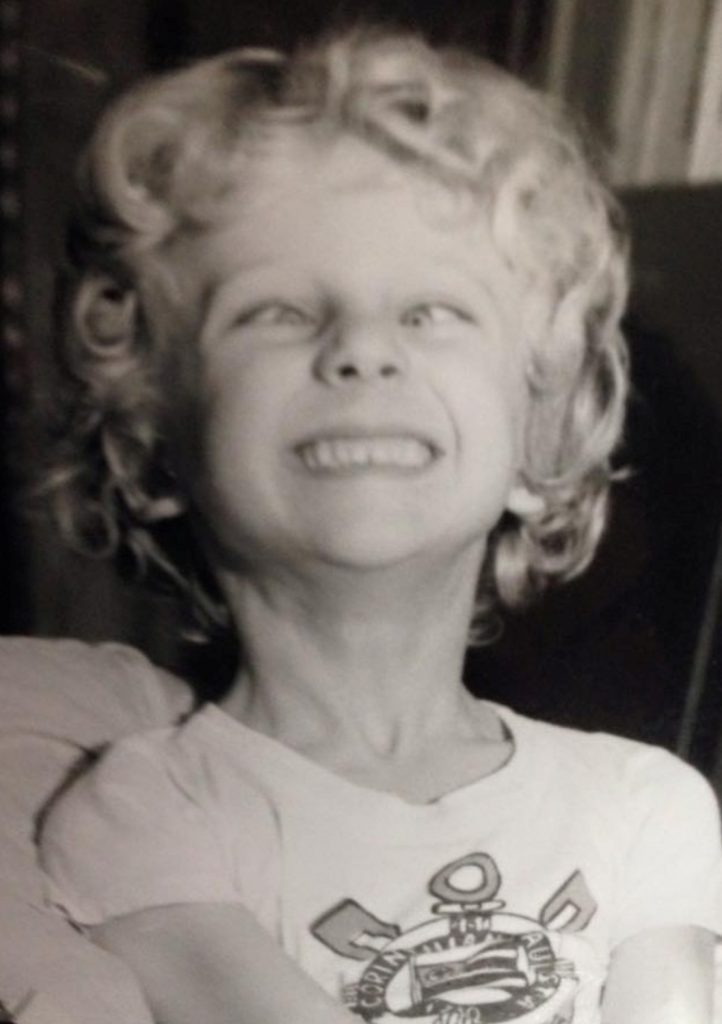
Over time, I made it into the junior team and the carousel of league matches, championships and tournaments began. The number of free weekends between April and October over the next twelve years could, figuratively speaking, be counted on the fingers of one hand. During the week I trained twice, usually three times, and spent most of my free time outside school on the tennis courts. I didn’t know discos, parties, and the only girls I knew were tennis players. I lived and breathed tennis.
I also remember when Boris Becker won Wimbledon in 1985. I was fascinated by how he threw himself around the court. I decided to try it too — and the results were… brutal. On the clay courts that were standard in Czechoslovakia at the time, my knees turned into bloody chunks of meat covered in clay almost every match. Blood ran down my shins onto my white socks, which gradually turned red. I’d walk off the court looking like a butcher who’d just taken apart a cow. Over time I perfected the technique and my success rate with those shots was pretty high. The spectators loved it, and I enjoyed turning a gentleman’s sport into a bloody spectacle.
Things started to shift around my eighteenth year. I was playing the Czech National League for the men’s team and began to realise that life had more to offer than just tennis. I also felt that performance‑wise, I wasn’t going to get much further, and the political changes of 1989 sped everything up. Tennis clubs, which until then had been oases in the middle of a totalitarian regime, suddenly attracted various nouveau riche types, wannabe businessmen and similar wankers. Playing tennis became a fashion statement and a symbol of social status. The ethos of the unique community that existed during the years of unfreedom was gone for good.
Like many of my peers, I had the chance — after the fall of the Iron Curtain — to go play in Germany, where you could earn money both playing and coaching. Many who left at that time still make a living from tennis today, and a few even made it to the ATP circuit.
I decided, literally overnight, to hang up my rackets. I was finishing high school, I was eighteen, and I set off into the next chapter of my life.
The Punk Detonation of the Nineties
I’d discovered punk a few years earlier (I write about it HERE), but once I quit tennis, I dove headfirst into a wild life. After school I started working as a carpet salesman and studied a follow‑up programme that was completely useless — except for one subject: English.
We were taught by Hynek Kmoníček — later the Czech ambassador to India, Australia, Vietnam, the USA and the UN. Intelligent, funny, fluent in English and Arabic, and a concert‑level guitar virtuoso. Back then he wore a stretched‑out sweater and, besides the mandatory and painfully boring Old English literature, he taught us things like the many uses of the word “fuck,” which is far more useful than knowing the alliterative verses of Beowulf. We also translated lyrics by Velvet Underground and Siouxsie & the Banshees, and occasionally he’d join us for a joint outside during the break.
Around that time I also discovered the Beat Generation — mainly Ginsberg and Kerouac. I devoured Charles Bukowski’s books. And I was blown away by Jim Morrison’s poetry collection An American Prayer.
Inspired by these writers and by anarchism, I wrote a poetry collection called Testosterone Solitude. My mother — a serious connoisseur of poetry — later described it as “the verses of a district‑level fucker”.
To this day I don’t know whether that was praise or criticism.
I also self‑published a booklet about the Sex Pistols and handed it out to my punk friends. I found a girlfriend, moved out of my parents’ place, and blasted into the nineties like a rocket.
From the first half of the nineties, I vividly remember Galerie‑Bar Nora — a cult Pardubice dive where punks, skaters, artists, alcoholics and various misfits gathered.
That’s where I met František Theer. A nobleman, but also the descendant of Czech writer Otakar Theer, a youth detention centre educator, national gymnastics champion, coach, intellectual and alcoholic. With a cigar in one hand and a shot of Fernet in the other, he spewed out his life stories like a mystical guru, and I listened eagerly as he described how he “somersaulted over the horns of enraged bulls.”
When he celebrated his sixtieth birthday there in the late nineties, an unbelievable crowd showed up. It ended in scuffles with the police, and the next day the newspaper Mladá fronta wrote about riots in Pardubice. I remember Franta with great fondness.
An Amazon Jungle in Smíchov
The nineties rolled into their second half and I woke up working in an advertising agency in Prague. The Pardubice crew gradually moved to the capital too, and most of them ended up in advertising just like me. A few of us moved into a basement space in a Smíchov apartment building. A legend was born — Citadela.
Food was scarce, but there was always enough beer and weed. And plenty of visitors. In the cramped space I also started keeping tarantulas, scorpions, and even bought a monitor lizard. They escaped regularly, so before going to bed I had to shake out the blankets to make sure there wasn’t a giant spider or a scorpion hiding inside. Crickets from the feeding boxes ran around the flat and chirped at night.
Citadela was like a slice of the Amazon rainforest in the heart of Central Europe, permanently wrapped in a cloud of marijuana smoke.
Kung Fu and Four Years of Summer Holidays
Years passed and I got into the martial art Wing Chun. After a few years I decided to dedicate myself to it fully. There was an international Wing Chun Kung Fu Academy in Australia, and since I had just broken up with my long‑term partner and nothing was keeping me in the Czech Republic, I decided to fly to the other side of the world.
I rented out my Prague flat, quit my job, gave away my spiders, scorpions and cat (the monitor lizard had escaped earlier in Braník), packed my things and suddenly found myself sitting on a plane to Brisbane. Only when we were flying over the endless taiga did I start thinking I might have completely lost my mind.
I was 38, had barely enough money for a month, no job, no roof over my head, and I knew only two people there — Viktor and Otto from the punk band Mouthguard, whom I’d met once on a Bohemians football away trip to Plzeň. We agreed that Otto would let me crash at his place for a few days. The only other thing I knew about my future was the date I was supposed to start school.
For a few weeks I washed cars in Surfers Paradise until I was finally invited to an interview at a five‑star hotel. In the hotel lobby there were fifty motivated applicants, including local Australians in suits with leather portfolios under their arms. I arrived on a bike from the car wash — sweaty, smelly, in shorts and flip‑flops. They were hiring two people. They chose me and a guy from Nepal.
Suddenly I had a well‑paid job, and the rest of the time I was at the academy, training every day. I enjoyed the beaches, discovered the local punk scene, travelled around Australia and the Western Pacific. It lasted four years. It felt like four years of summer holidays.
Eventually I decided to return to Europe. On the way I spent some time in Hong Kong, where I trained with a teacher who, in the early 1950s, had been one of the five closest students of the legendary Ip Man — and who later taught Bruce Lee.
Through Indonesia, Malaysia, the Philippines and Japan, I finally made my way back to Europe. Going to Australia was one of the best decisions I’ve ever made.
Return to Europe and London
After a few months back in the Czech Republic, I moved to London, where I’ve now lived for more than ten years and eventually became a British citizen. Life is just a series of decisions that often make sense only in hindsight. And so I keep going. I don’t dwell on what’s behind me, and I don’t look beyond the horizon of what may come. I’m here, in this moment. Without a manual, but knowing that this is exactly what makes it great.