


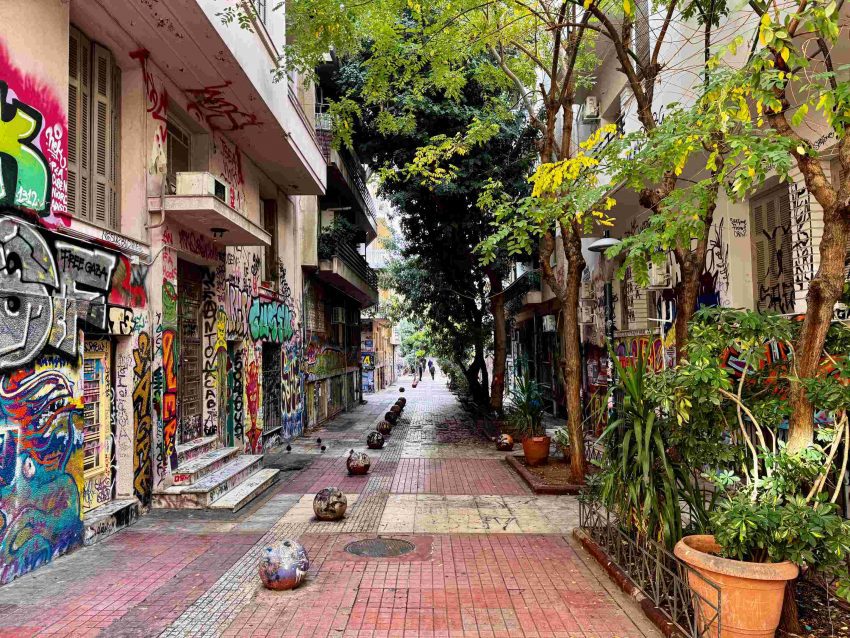
This year I decided to take a several-day pre-Christmas trip to Athens. My goal was not the ancient monuments, but the district of Exarchia. This part of Athens is well known for its alternative and anarchist spirit. And perhaps by coincidence, it was exactly the weekend when the annual protests against police violence take place, commemorating the murder of fifteen-year-old Alexis Grigoropoulos, shot by a policeman in 2008. And perhaps it was a double coincidence, as it was almost exactly 35 years to the day since I took part in a major protest against police violence in Göttingen, Germany.
1973: The Uprising Against the Military Junta
Much like Berlin’s Kreuzberg, Christiania in Copenhagen, or St. Pauli in Hamburg, Exarchia belongs to the European centers of anti-authoritarian movements and alternative culture. Its modern history began in 1973, marked by the bloody suppression of the student movement against the military junta that had ruled Greece since 1967. On November 17, International Students’ Day, students occupied the building of the National Technical University in Exarchia and declared resistance against the regime that restricted freedom and democracy. The streets of Exarchia became the center of protests. Students built barricades, printed leaflets, and called for freedom of speech and life. The junta responded with brutal force, as tanks entered the university grounds and subsequent gunfire claimed dozens of lives and left hundreds wounded. The military junta finally fell a few months later. Incidentally, the original more than fifty-year-old iron gate, torn down by tanks at the time, can still be seen as a memorial at the entrance to the university campus.
Exarchia Today
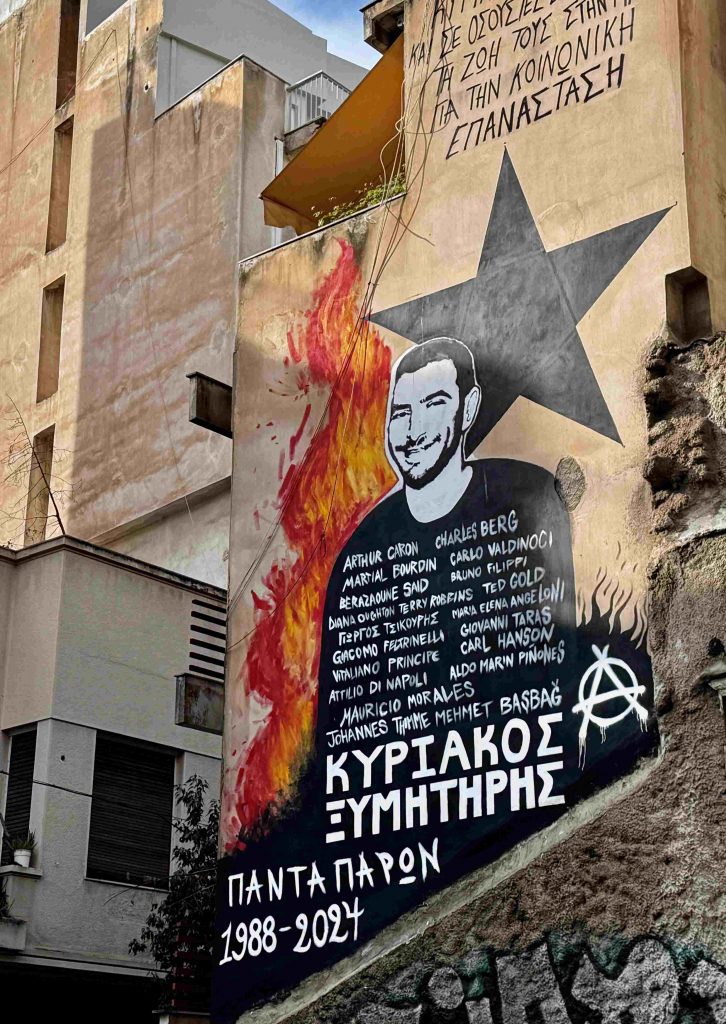
The current face of Exarchia is formed by a colorful mix of residents: students, intellectuals, musicians, squatters, migrants, and old Athenians. There is also a strong sense of solidarity and a desire to live freely without interference from state power. In recent years, a network of squats emerged here, providing housing for migrants and refugees outside the official state system. Abandoned houses became shelters mainly for families with children and vulnerable individuals who would otherwise have ended up in overcrowded camps or on the streets. The squats operated on principles of solidarity, self-organization, and mutual aid, without state subsidies. After state intervention, however, they were gradually cleared, and solidarity with refugees shifted mostly into private apartments. The local streets are also full of bookstores, cafés, small shops, comic stores, bars, and nightclubs. The walls of buildings are continuously covered with graffiti and political posters. Facades serve as memorials, showing the faces and names of fallen and tortured fighters for freedom from all over the world. This diversity, creativity, and determination give Exarchia its unique character. Exarchia is, in short, a living symbol of resistance, where anger does not fade and ideals have not softened over the years.
Photo gallery from Exarchia is HERE.
The Murder of Alexis Grigoropoulos and Protests Against Police Violence
As I mentioned in the introduction, on December 6, 2008, fifteen-year-old Alexis Grigoropoulos was shot dead by a policeman in Exarchia. The policeman, Epaminondas Korkoneas, claimed that Alexis and a friend had thrown a bottle at their passing police car. Together with colleague Vasilis Saraliotis, they returned on foot to confront the boys, supposedly to “teach them a lesson.” Korkoneas pulled out his gun and, according to his testimony, fired two warning shots. But both were aimed directly at Alexis’s chest. The subsequent investigation proved beyond any doubt that it was a cold-blooded murder. Korkoneas was sentenced to life imprisonment in 2010. His colleague received ten years but was released shortly afterward. In 2019, Korkoneas’s sentence was reduced to 13 years on appeal, and he was released soon after, having served the required portion of the sentence. This sparked further outrage, not only within the Exarchia community.
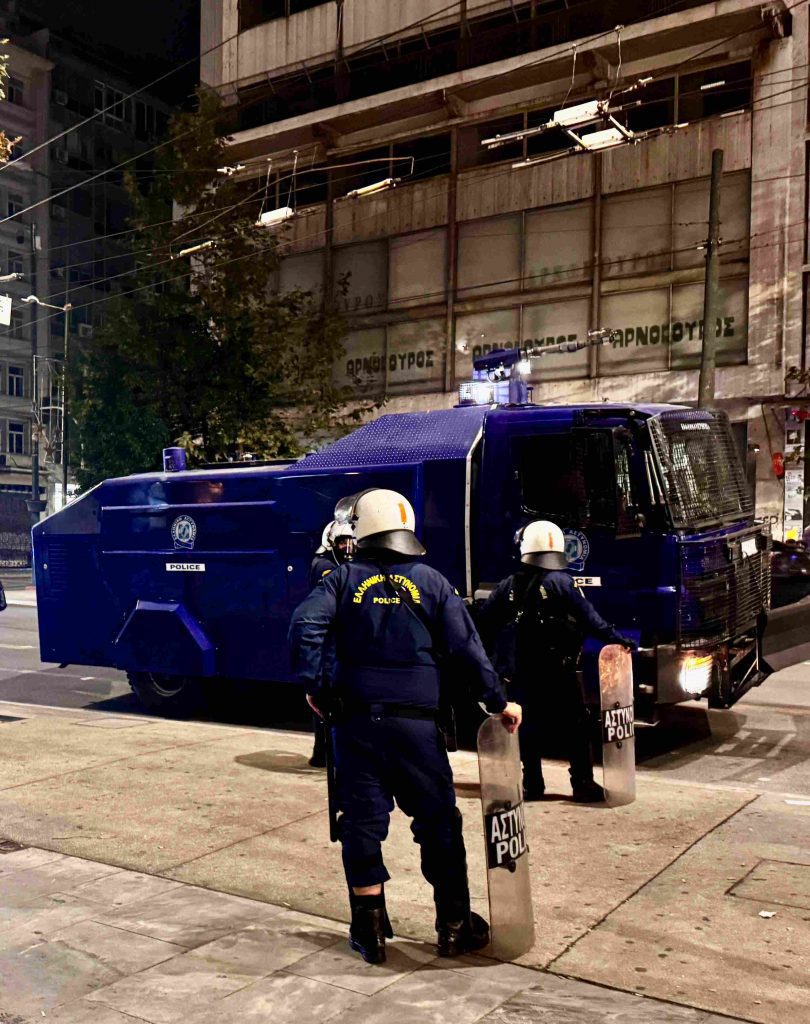
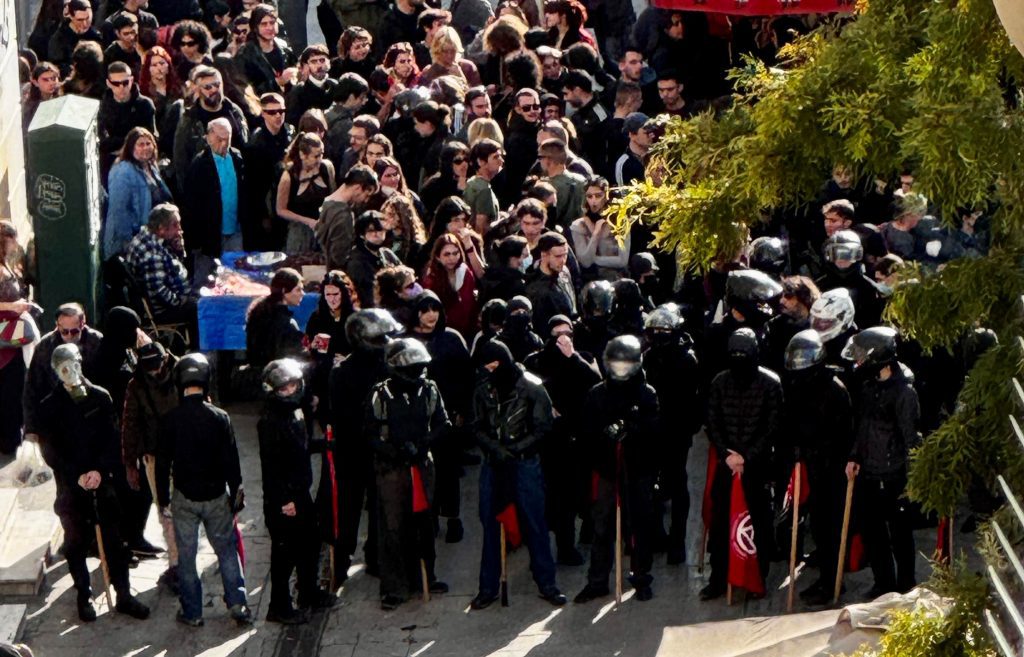
From early morning I noticed increased police activity around Omonia Square. Police officers in full gear with helmets, shields, batons, and tear gas. Water cannons were also present. At the same time, groups of protesters began to appear. Mostly students, but also visually unified, black-clad “black bloc” members with motorcycle helmets, gripping sturdy wooden sticks with red-and-black anarchist flags. In the evening, a march of about 5,000 people set off through the streets, chanting loudly. At one point, the front tried to turn off the pre-announced route. The way was blocked by a cordon of riot police. The first clashes broke out. Police used stun grenades and tear gas. A cloud of irritant gas then rolled down the wide street to the sprawling Omonia Square. People sitting in outdoor cafés and passersby wiped their streaming eyes, and even the homeless, until then peacefully dozing on the ground among rags and cardboard boxes, were awakened. Everywhere there was the sound of choking coughs. A group of girls treated a head wound of some boy. Protesters then split up. Some went home, others continued to the memorial site of Alexis Grigoropoulos in Exarchia. News servers reported that several dozen people were detained, four of whom were eventually charged.
A Few Tips
Hotel Elikon, where I stayed, I can recommend as an ideal base, whether you head to Athens for monuments or for Exarchia’s nightlife. It is located in close proximity to Omonia Square, from where you can easily take the metro to the airport or to the Acropolis, which is just 15 minutes away. The streets of Exarchia are less than ten minutes on foot. The National Archaeological Museum is also nearby. Entrance to the Acropolis is free on the first Sunday of every month. If you are a lover of fish and seafood, be sure to visit Trata Fish Tavern in Exarchia. Absolutely fantastic!