


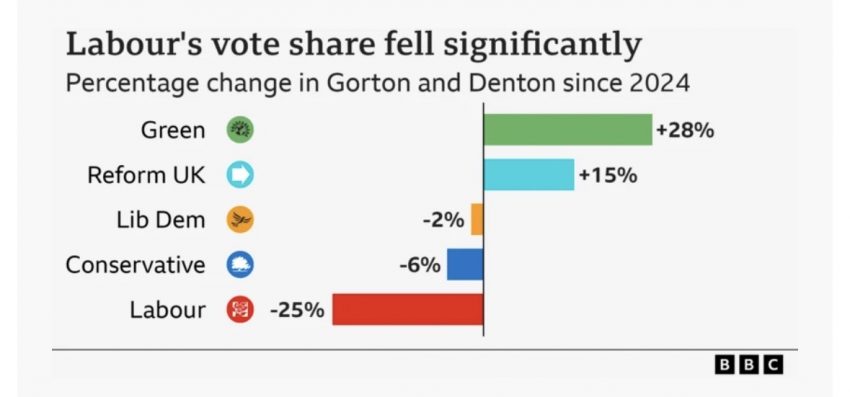
The UK by-election held on 26 February in Gorton & Denton (Greater Manchester) shook the political scene more than any other local contest in recent years. A constituency long considered an impregnable Labour stronghold fell to the Greens for the first time, while Reform UK took second place and the governing party finished only third. A result that would have seemed like political fantasy just months ago became reality, revealing deep voter dissatisfaction with the mainstream, fatigue with the Labour government, and a growing appetite for alternatives.
The victory of Hannah Spencer — a plumber and local councillor — is therefore not just a one off protest but a symptom of a broader shift that could significantly redraw the map of British politics in the coming years. After this genuinely shocking result, the far right populist Reform UK filed a complaint alleging electoral breaches related to so called “family voting” and accused the Greens of promoting sectarianism.
Taking it step by step: “Family voting” in the British electoral system refers to situations where one family member influences or directly controls the voting of another. Typically this means entering the polling booth together, watching how the person votes, or telling them whom to vote for. Although it may appear as “innocent help”, it violates the principle of the secret ballot and has been illegal in the UK since 2023. Observers have repeatedly recorded this practice in some communities, and in the recent Gorton & Denton by election they reported instances of “family voting” in a significant proportion of the polling stations they monitored. I can imagine that in strongly patriarchal Muslim families this phenomenon may be relatively common. At the same time, I have to ask what the local electoral commission is there for if not to prevent such cases on the spot.
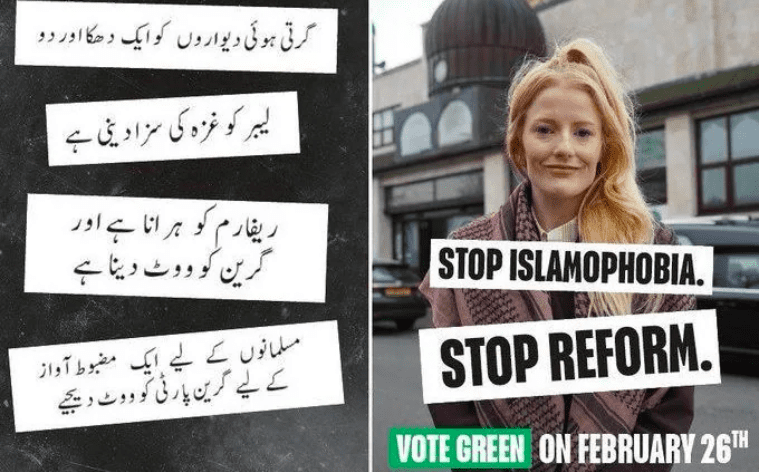
The other accusation concerns sectarianism. Reform UK has suggested that in some parts of the constituency people voted according to group identity — that is, “block voting” based on religious or ethnic affiliation rather than party programmes. As evidence, they point to one campaign leaflet showing candidate Hannah Spencer photographed in front of a local mosque, wearing a keffiyeh, with text in Urdu — a language spoken mainly in Pakistan, from where a significant part of the Gorton & Denton electorate originates. Reform UK representatives also claim that Green activists frequently urged voters during the campaign to “punish Keir Starmer’s government over Gaza” by voting Green.
Green Party leader Zack Polanski (himself of Jewish background) declared after taking over the party last year that one of the Greens’ goals is to stop Reform UK. Polanski repeatedly says he wants to “take populism back” and use its simple, accessible language to advance green and socially just policies. He openly states that he studies Reform UK’s tactics and Nigel Farage’s style in order to turn them against them and reach voters who feel politically abandoned. His strategy manifested itself clearly for the first time in Gorton & Denton — and it clearly works.
Although I’m glad Reform UK didn’t win, I have very mixed feelings about the result. I expressed those feelings already last year HERE, after I left the Greens following Polanski’s election as leader. I absolutely reject any form of Islamophobia, but equally any form of antisemitism. That was a significant problem in parts of the Labour Party, especially among some supporters around Jeremy Corbyn. As Labour voters shift towards the Greens, those who openly hate Jews shift with them. That’s simply a fact.
The uneasy aftertaste of the Gorton & Denton by election is underscored by an incident that happened last night, when someone sprayed the statue of Winston Churchill on London’s Parliament Square with the slogans “Zionist war criminal”, “Free Palestine”, “Globalise the intifada”. British politics is heading into turbulent times. I don’t know how it will end. What I do know is that I refuse to choose between hatred of Muslims and hatred of Jews.