

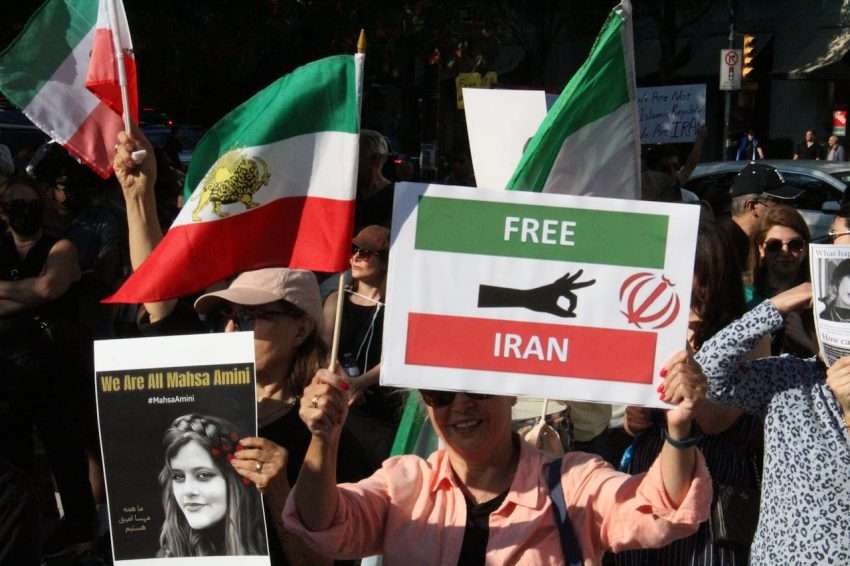
It’s fascinating to watch how the war in the Middle East echoes through multicultural London. The city is home to at least 40–60 thousand Iranians. A strong concentration of shops, restaurants, community centres and politically active diaspora can be found mainly on Ballards Lane in North Finchley, nicknamed “Little Tehran”. And as one might expect, this diaspora is deeply divided. Here you’ll find both supporters of the theocratic regime and its opponents, including many exiled journalists, dissidents and students.
When protests meet: Iranians and Ukrainians
About a year ago, I attended a Ukrainian protest outside the Prime Minister’s residence. At the same time, an anti‑regime Iranian gathering was taking place on nearby Trafalgar Square. When it ended, the march moved towards the Ukrainian demonstration, and as it passed, Iranians and Ukrainians hugged, chanted together, and waved Ukrainian and pre‑revolutionary Iranian flags (the one with the lion and sun symbol in the centre). It was a powerful moment, and I felt that what truly united both groups was the desire for freedom.
Demonstration of Regime Opponents
Some time ago, I attended a protest held by Ukrainians outside the Prime Minister’s office. At the same time, on nearby Trafalgar Square, there was a gathering of Iranian opponents of their regime. When their event ended, the march set off toward the Ukrainian demonstration, and as they passed by, Iranians and Ukrainians embraced, chanted together, and waved Ukrainian and pre‑revolutionary Iranian flags (the one with the lion and sun emblem in the white field). It was a powerful moment, and I felt that what truly connected both groups was their shared longing for freedom.
By complete coincidence, during a walk through springtime London yesterday, I once again came across a demonstration of Iranians protesting against the theocratic regime. A wave of pre‑revolutionary Iranian flags rolled down the street, mixed with American and Israeli ones, and portraits of Reza Pahlavi were visible everywhere. I genuinely wish for the current regime to fall, yet I’m fully aware of how incredibly difficult that will be. It’s clear that the United States primarily pursues its own interests, which overlap with those of these freedom‑minded Iranians only to a certain extent — and the unpredictable Trump could abandon or trade them away at any moment. Israel, whose interests align with those of the U.S. far more than with the Iranian opposition, follows its own course, and once it achieves its goals, the matter is effectively closed for them. For Israelis, it matters little who governs Iran, as long as that government does not pose a threat.
Pro‑regime demonstrations and the banned march
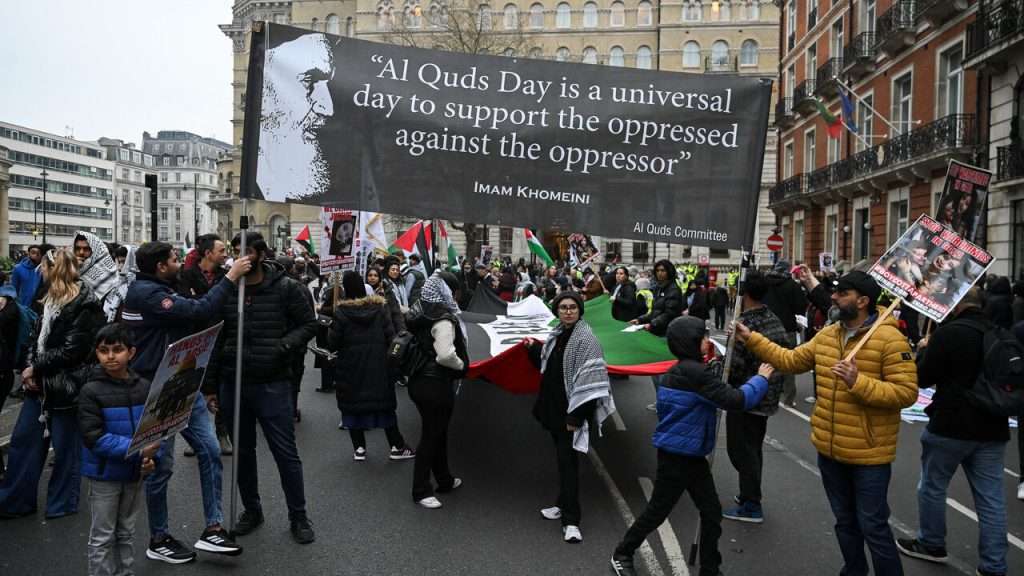
And then there are the demonstrations of regime supporters. This year, for the first time since 2012, the British government banned the planned Al Quds Day march of pro‑regime supporters in London after the Metropolitan Police warned of a “serious risk to public order” due to the scale of the event and several counter‑protests. Home Secretary Shabana Mahmood approved the ban, citing the tense situation in the Middle East and the possibility of clashes between pro‑Iranian groups and their opponents. Instead of a march, only a static demonstration under strict supervision was allowed.
REUTERS/Jaimi Joy/File Photo
At their rallies, you’ll see the flag of the Islamic Republic with the “Allah” emblem in the centre and the repeated “Allāhu Akbar” inscription along the green and red stripes. Alongside it are countless Palestinian flags and portraits of the ayatollah. And just as anti‑regime Iranians embrace Ukrainians — and now even Israelis — here you see supporters of a theocratic regime marching side by side with representatives of the pro‑Palestinian left, which feels more than absurd. Marx’s description of religion as “the opium of the people” clearly no longer applies. Times are changing. And who knows — perhaps soon we’ll see this segment of left‑wing activists even at neo‑Nazi demonstrations, because “Zionism”, after all, is their shared enemy.