

This famous Hamburg district is far more than just brothels and red lights, as many might imagine when they hear its name. St. Pauli has many faces, all defined by openness, tolerance, and the feeling that “everyone belongs here.” For me personally, that’s doubly true. In the Czech Republic, I grew up just a few metres from the River Elbe, and perhaps that’s part of why I feel just as much at home on its banks some 750 kilometres downstream.
The smell of fish, the river, and old seafaring tales
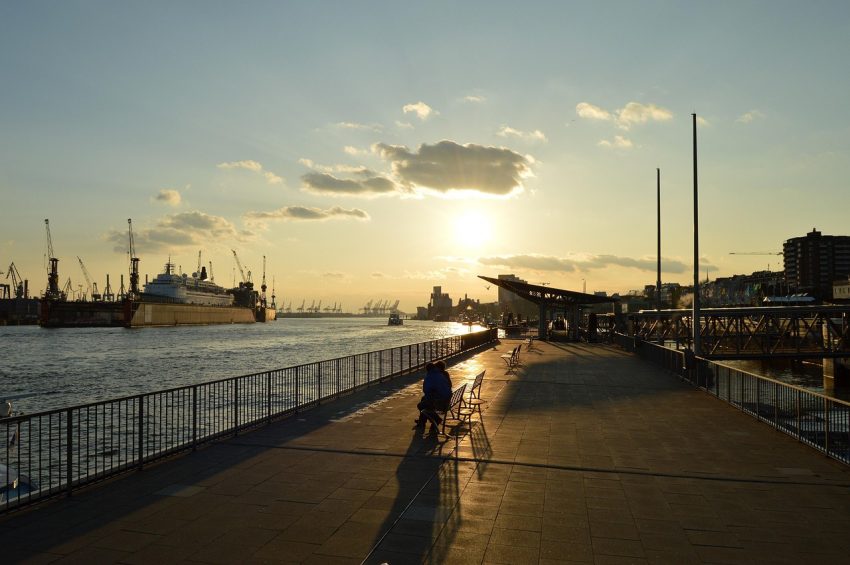
The most romantic part of St. Pauli stretches along the right bank of the Elbe and perfectly captures the spirit of a river city close to the sea: fish markets, traditional sailors’ pubs, and the famous Fischmarkt. At the Landungsbrücken piers, excursion boats are moored, and you’ll also find plenty of food stalls dominated by dishes made from fish and seafood. Perhaps the most typical delicacy is smoked eel — an absolute treat.
Under the neon lights that know every sin
A short walk from the river toward the Reeperbahn boulevard lies Herbertstraße, known as one of the most traditional centres of Hamburg’s sex industry. Behind gates marked “Entry forbidden to women and minors” hides a world of display windows where workers have been offering their services for more than a hundred years. This street is not a tourist attraction but a living part of St. Pauli’s harbour history, still preserving its own rules, order, and rough authenticity.
Here are a few rules visitors must follow:
- Entry is allowed only for adult men
- Behave quietly and respectfully
- No photography
- Don’t linger at the windows — it’s considered disrespectful
- Cash only
Herbertstraße is short, straight, and functional. It’s no spectacle like the venues on the nearby Reeperbahn, although that pulsating boulevard is just a stone’s throw away. It’s a long, wide artery where neon lights reflect on wet pavement and where the night has a completely different energy than anywhere else. Bars, sex shops, gay clubs, cabarets, and venues that don’t even try to hide their reputation. Everything here lives loudly: music, lights, tourists, and locals.
Punk and football
Once you cross the Reeperbahn and continue further, you suddenly find yourself — as if by magic — in the epicentre of resistance and alternative culture, where the beating heart of everything is the football club FC St. Pauli.
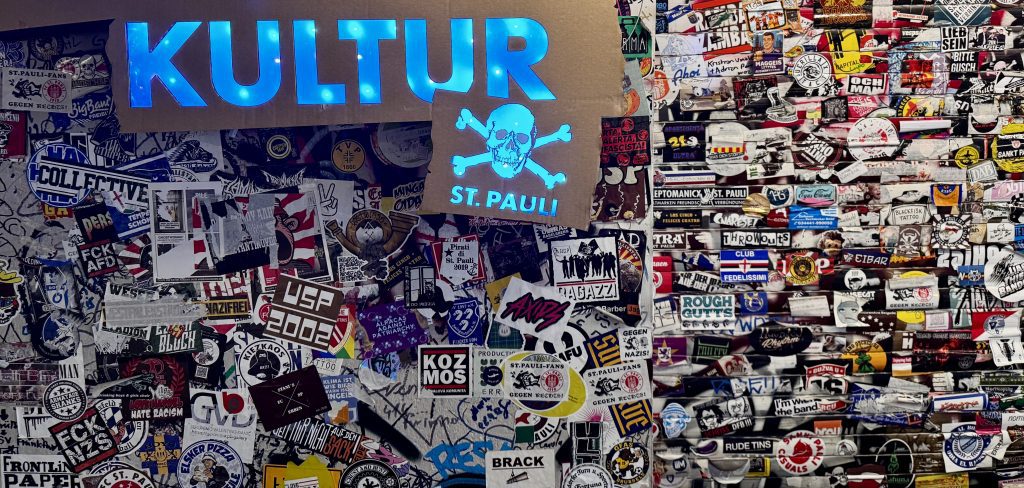
The alternative identity of St. Pauli began to take shape in the 1980s, when the city planned large-scale demolitions of old apartment buildings on Hafenstraße. The plan was meant to clear space for new development projects, but locals saw it as a threat to a community that had lived there for generations. Massive resistance followed. Buildings were occupied by squatters, barricades were built, and protests lasted for months. It was then that another face of St. Pauli emerged — a symbol of the fight against the establishment, police pressure, and a laboratory for new forms of community life.
During this period, St. Pauli gradually became a centre for autonomous groups, squatters, the punk scene, antifascist collectives, social projects, and DIY culture. Community kitchens, cultural centres, concert spaces, and political initiatives began to appear — shaping the character of the district up to the present day.
The energy of resistance, solidarity, and creativity eventually flowed into the football club FC St. Pauli as well. The club transformed from an ordinary team into a global symbol of antifascism, inclusion, and subcultural identity. Today it is a brand representing far more than sport. The club now has hundreds of official fan clubs around the world — from Australia and India to Europe, Latin America, the USA, and Canada. Walking through graffiti‑lined streets, you eventually reach the Millerntor Stadium, with a capacity of 30,000 spectators. Every match is hopelessly sold out, and plans are already underway to expand the capacity to 50,000 within the next fifteen years. And when you’re there, don’t miss the club’s fan shop. You’ll see with your own eyes that Millerntor — owned, by the way, by the fans themselves — is unlike any other stadium. On its roofs lie extensive solar panels in the rainbow colours of the LGBTQ+ community, producing electricity for the club and the surrounding area, symbolising exactly what FC St. Pauli stands for: football connected with responsibility, activism, and concrete action.
Twenty years of friendship — my journey with St. Pauli
I’ve been regularly attending St. Pauli matches for more than twenty years. It all began with our group of Bohemians Prague supporters taking part in the traditional Antira fan tournament organised by FC St. Pauli supporters. It was at a time when Bohemians fans were the first in the Czech Republic to openly embrace the values of anti‑racism and anti‑fascism. The Bohemka team faced supporters of famous clubs such as Celtic Glasgow, Athletic Bilbao, Atalanta Bergamo, Hapoel Tel Aviv, FC Sevilla… and thanks in part to our rich experience from the Hanspaulka amateur league, we repeatedly achieved many valuable victories.
Besides attending Antira every year, we also began travelling to FC St. Pauli’s home matches, as well as to some away games — especially those close to the Czech border. We also formed a strong friendship with the St. Pauli Skinheads group, and over the following years we regularly visited each other outside football events as well. Legendary parties took place at Prague’s Újezd or in their home pub, Jolly Roger.
This friendship has lasted to this day, and this January we set off for the long‑awaited Hamburg city derby. It was the first Bundesliga meeting of the two city rivals at Millerntor in fifteen long years. We simply couldn’t miss it, and despite the freezing –4°C temperatures, we enjoyed not only the match itself but the entire weekend — as always.
FORZA FC ST. PAULI!
A few tips
If you want to take a boat trip on the Elbe, the cheapest and perfectly sufficient option is the boat that operates as part of the city’s public transport system. The best time to visit the fish market is at sunrise, when the atmosphere is at its best. It opens every Sunday morning (at 5:00 in summer, 7:00 in winter) and closes at 9:30.
From the pubs, I recommend St. Pauli Eck, the bar Tiefgang, and of course the legendary Jolly Roger. If you enjoy crime stories, be sure to visit the classic dive bar “U Zlaté rukavice” (Der Goldene Handschuh), where in the 1970s the serial killer Fritz Honka drank and sought out his victims among Hamburg’s prostitutes — and where part of Fatih Akin’s film of the same name takes place.
Links
Official club website: FC St. Pauli | Home
Documentary about FC St. Pauli (ENG): FC St. Pauli | Inside Bundesliga’s Most Diverse Football Club | Sports Illustrated – YouTube