


On 22 April 1993, eighteen‑year‑old Black student Stephen Lawrence was murdered in a racially motivated attack in Eltham, London, while waiting for a bus. Stephen was assaulted by a group of five white youths who stabbed him. It was an unprovoked attack.
The following day, the police received an anonymous letter naming the suspects. They were a group of young men from southeast London who had long been associated in the local community with violence, criminal behaviour and racist attitudes – Gary Dobson, David Norris, Luke Knight, Neil Acourt and Jamie Acourt.
From the very beginning of the investigation, it was clear that the police were failing in a serious way. Officers at the scene did not provide first aid to the dying Stephen, ignored witness statements, failed to carry out basic procedures and allowed key evidence to be lost. Stephen’s family gained the entirely justified impression that the police were not acting as they should because he was “just a Black boy”.
In May of the same year, Nelson Mandela visited Britain and personally requested a meeting with the Lawrence family. This drew significant media attention, especially after he publicly stated that the murder of Stephen Lawrence revealed deeply rooted racism in British society and that the Lawrences’ fight for justice was part of a broader struggle for human rights. Suddenly, things began to move.
The following year, the police charged five suspects. However, the Crown Prosecution Service later dropped the case due to insufficient evidence. The Lawrence family’s frustration grew, and in 1996 they decided to bring a private prosecution. This carried great risk, because if the court found the defendants not guilty, they could never again be tried for the crime (the principle of double jeopardy). Due largely to the police’s mishandling of the early investigation, the jury ultimately acquitted the defendants.
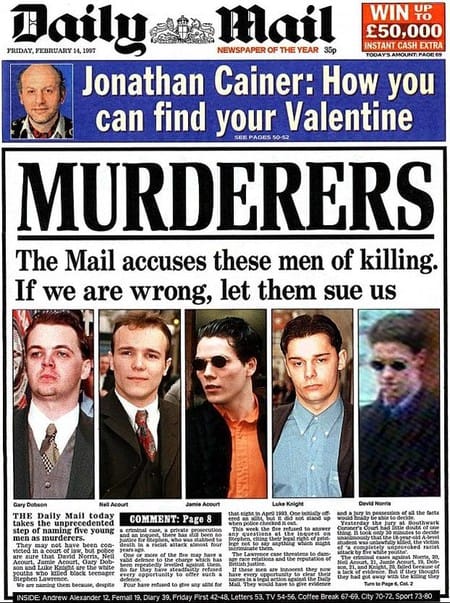
Another turning point came on 14 February 1997, when the tabloid Daily Mail published photographs of the suspects on its front page with the headline MURDERERS and the sub‑headline IF WE ARE WRONG, LET THEM SUE US. No lawsuit followed; instead, events began to move again – this time rapidly and irreversibly.
After several weeks of public pressure, the government announced the launch of an independent public inquiry. The so‑called Macpherson Inquiry was established, and in 1999 it published its final report with a key conclusion: the Metropolitan Police is institutionally racist. The commission recommended 70 reforms affecting the police, the justice system and public administration.
In the following years, many of these reforms were implemented – from redefining racially motivated crime, to training police officers about racism, to changes in policing procedures. A change to the double‑jeopardy law for the most serious crimes was also introduced.
Between 2006 and 2010, new forensic technologies made it possible to analyse microscopic DNA traces. Based on these findings, Dobson and Norris were charged again in 2011, and a year later found guilty of murder. Dobson received a 15‑year sentence and Norris one year less. Eighteen years after the murder, the family finally received a measure of justice.
Stephen Lawrence Day was established as an officially recognised memorial day in the United Kingdom, focused on education, equality and civic responsibility.
In 2014, Stephen’s mother, Doreen Lawrence, was appointed a baroness and became a member of the House of Lords, where she contributes to legislation, oversees policing and actively participates in debates on racism.
The story of Stephen Lawrence and his family has become a symbol of how the persistence of ordinary citizens can force a rigid system to change.